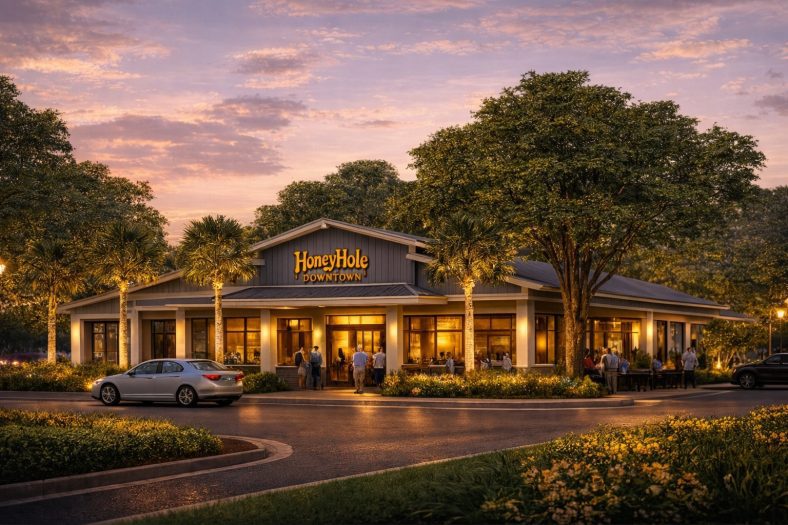
In Parts One and Two of this series, we explored how Downtown Bonita Springs arrived at this pivotal moment – and why so much progress seems to be building all at once. We talked about momentum, missed opportunities, live music drifting through Old 41, the rise of walkable districts, and the power of building places that bring people together. In this final chapter, the conversation turns forward. Kyle Moran shares his vision for his newest project, HoneyHole Downtown, and what he believes the future of Bonita Springs can look like when development, culture, and community are treated as inseparable.
Inside Honeyhole: A New Vision for Bonita’s Downtown Experience
Bri: We’ve talked a lot about Sugarshack Downtown and touched on Project Telephone – but this next phase feels different. It is on the same block as Sugarshack, fronting the roundabout on the corner of Ragsdale and Old 41. In the past, you called it Project Roundabout, but you have a new name. What is it? And what’s it about?
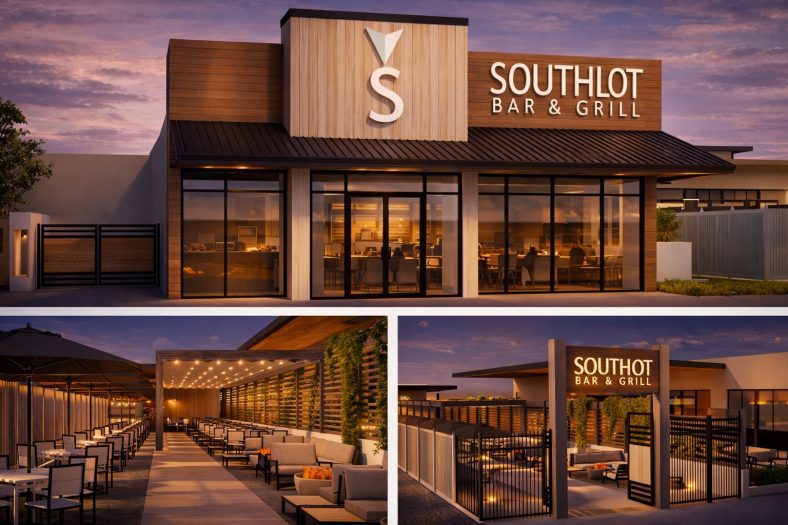
Kyle: It’s HoneyHole Downtown, and it’s about experience first – not just a great restaurant, not just jaw-dropping live music, not just dynamic bars, not just immersive merchant spaces, but a place people discover and then can’t stop coming back to.
The idea is that it feels intimate from the outside, almost understated. But on the inside, like when walking into an enchanted forest enclave, it opens up in a way that surprises you. It’s layered. It’s immersive. It’s social. It’s designed so a hundred different nights can happen at once – and each one feels personal.
Bri: HoneyHole – that’s attention-grabbing. What does the name mean?
Kyle: Some think it’s a fishing term – what anglers call a spot where the fish are always biting. A secret and special place that always delivers. But a honey hole can also be an opening in a tree where a hive of bees produces honey. That connection to a special tree and to a hidden area that buzzes felt meaningful.
Bri: That feels symbolic, given how much you talk about designing around nature, instead of getting rid of it to make way.
Kyle: Nature preservation is extremely important to keep in mind as the landscape changes. It is one of the big factors that keep a city from feeling “overdeveloped.” Downtown Bonita Springs has incredible natural beauty with a great riverfront, but also with its trees.
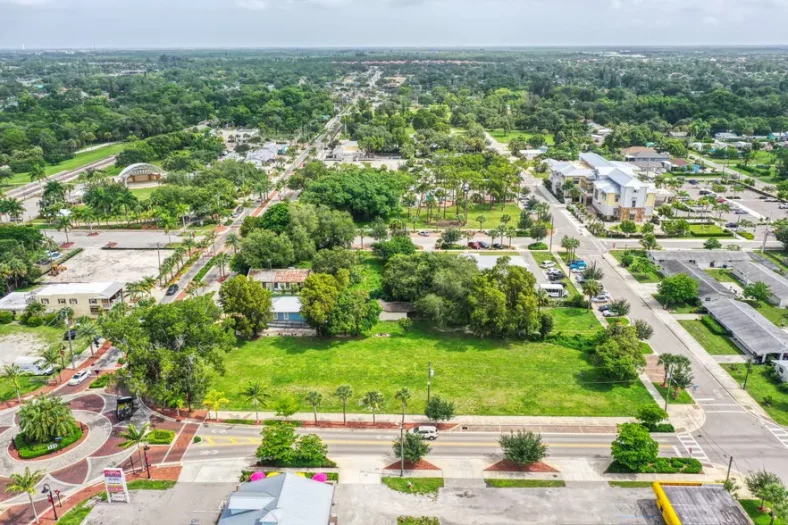
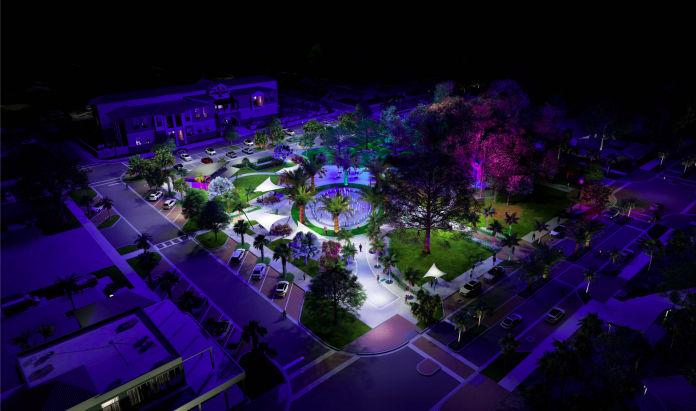
When we built Sugarshack, we worked hard to protect and integrate the heritage oaks on site. Across the street, the City’s signature banyan tree will anchor a newly improved park coming soon. Shangri-La is home to record-sized Mysore figs. And right at the HoneyHole roundabout stands a majestic mahogany soaring seven or eight stories into the sky – one we are doing everything possible to preserve.
When you build around great trees, you are not only preserving nature, but it also making people slow down. When people slow down, they start discovering new experiences and one another. That’s how community is built.
Bri: The idea of “discovering” keeps coming up. Why does that matter?
Kyle: The most memorable places reveal themselves slowly. They offer far more on the inside than they suggest from the outside – the kind you stumble into and, over time, start to feel are yours.
When people believe they’ve uncovered something special, they treat it differently. They bring friends. They celebrate birthdays and anniversaries there. That’s how community spaces are born. We’ve seen it firsthand at Sugarshack Downtown – from countless celebrations to more than a few marriage proposals.
HoneyHole will have a different feeling, but we hope it carries that same sense of magic.
Bri: You’ve talked before about scale – building something big enough to be sustainable, but not intimidating. How does that concept carry into HoneyHole?
Kyle: That balance is one of the hardest things to get right.
From the street, HoneyHole Downtown — like Sugarshack — should feel approachable. Human-scaled. Comfortable. Behind that is real operational scale: enough seats, enough flexibility, enough energy to support a great team, a big enough stage for great bands and great music, and long-term success.
If you don’t build with scale, the business doesn’t survive. But if you build only for scale, you lose soul.
Bri: During our walkthrough, you kept pointing out sightlines, courtyards, and how people move through the space.
Kyle: Good development is never static; it choreographs movement the way a great partner leads a dance – intuitively, and with grace.
How do people enter? Where do they pause? Where do they linger? Where do kids drift? Where do adults relax? What does the stage look like when the band hits that unforgettable note?
Great spaces don’t force interaction – they invite it. And when you get that right, people stay longer, feel better, and connect more.
Bri: You’re very open about designing for families. That means a lot to me.
When my husband grew up here in Bontia, he definitely did not have the same experience our daughter is. There has been such a shift in focus to families downtown and we love it. The light displays, the park events, Trick-or-treating downtown, the new Splash Pad – It is so refreshing in an area with a historically older population.
Kyle: Absolutely. Of course, it hits a personal level for people like us who have children growing up here, but even if you don’t have kids, it matters if you care about the future.
Sure, with its fifty or so gated communities, Bonita has more than its share of retired or nearly retired folks. They make great customers because they possess life’s two most valuable commodities, time and money. So, naturally, the hospitality tends to focus on that generation. But Bonita has lots of diversity, and all ages.
Bonita Springs is attracting young families in a big way. If you don’t give them places where kids are welcome, not tolerated, but genuinely considered, you lose them.
We’ve seen firsthand how family-friendly spaces create energy at Rooftop and Sugarshack. At HoneyHole, we want to go even further, including a unique immersive play experience for kids so parents can relax, enjoy music, and spend time together. When kids are happy, adults can relax, and everyone has a better time.
Bri: Amen to that! Let’s talk about that mahogany tree you mentioned earlier.
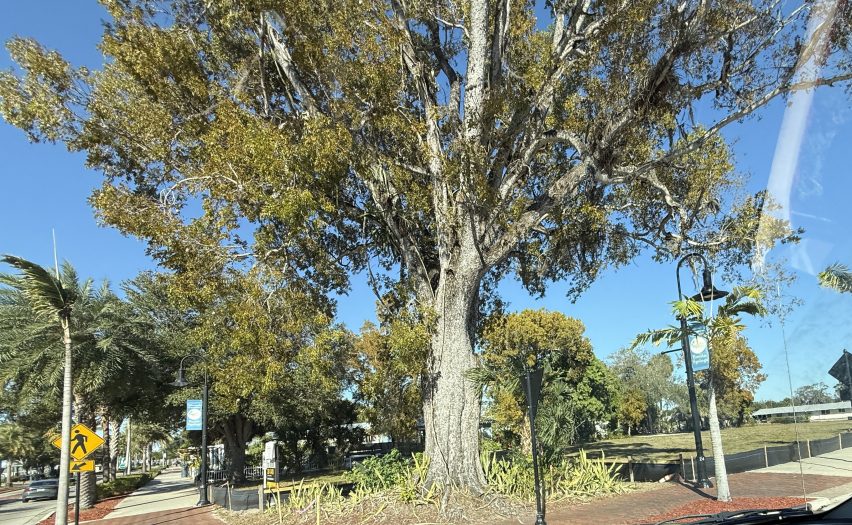
Kyle: It’s extraordinary – right in the southwest corner of the site, towering over the roundabout south of Sugarshack. The City even narrowed the sidewalk there years ago to try to save it.
When I first bought the parcel, an arborist recommended removal. He worried about root stress and rot. But we didn’t feel right about that.
We believe that the tree is more than a century old. It’s watched the town grow around it. So we brought in new arborists and have the team working to preserve it long-term. We’re even rerouting our own sidewalk behind it so people can walk comfortably under the canopy instead of squeezing past traffic. We want that tree to stay and to provide calm, comfort, and beauty for many more generations.
Bri: Your approach and way of thinking make a lot of sense to me. How does it align with the City’s goals and objectives?
Kyle: The City has done a lot of amazing work to build a foundation for the revitalization of the Downtown. We are really following the plan laid out in their most important documents. It starts with the City’s Comprehensive Plan, the long-term plan required for every City by State law, essentially the Constitution of a city. In Bonita’s case, it’s crystal clear: Downtown is meant to be the vibrant center of daytime and evening life, a gathering place for all ages, with a distinctive mix of restaurants, retail, public events, and entertainment.
Bri: Yeah, and we know the City has done a lot more than just planning documents to build and program Downtown.
Kyle: So much more. The City has invested heavily in infrastructure and public spaces to make that vision real. Every study, code change, and public capital project has been aimed at the same goal spelled out in the Comprehensive Plan: a Downtown alive day and night with dining, entertainment, and shared experiences. And that’s what we are trying to deliver on for the community, together.
Bri: Switching gears, I am thinking about how you said HoneyHole will be a restaurant and bar with great live music and entertainment. That sounds a lot like Sugarshack. Won’t they cannibalize one another?
Kyle: It’s a fair question. They share some DNA, but they’ll differ meaningfully in team, menu, and overall experience. Sugarshack is largely outdoors; HoneyHole will be mostly indoors, with greater scale and a more immersive, discovery-driven environment. Both, however, are live music driven – and that shared energy, combined with their proximity, will make each of them stronger. Together, they create critical mass: a compelling reason for people to come Downtown.
You see it in luxury retailers clustered in malls, car dealerships lined up in a row, convenience stores side-by-side, and fast-food restaurants on opposing street corners.
I first saw it as a college kid in Philadelphia with Pat’s and Geno’s cheesesteaks. They face each other – and together became the de facto cheesesteak capital of the world, a true culinary destination. They’re just two sandwich shops, but in the birthplace of the nation, they’ve become a must-visit stop.
And the opportunity here is unique and enormous. Philadelphia has no shortage of cheesesteaks – you can get them anywhere. But as we touched on before, Bonita desperately needs more dining options, and Southwest Florida desperately needs better entertainment choices.
Our region may rank among the highest in the world for concentrations of people with time and money, but one of the lowest for compelling entertainment experiences. The opportunity is massive. Demand dwarfs supply. The two together are not slicing a fixed pie; they are building the bakery.
Bri: You’ve also talked about activation versus gentrification when we’ve spoken previously. Can you touch on that?
Kyle: Right. Gentrification is about replacing something typically unique and family-sized with something generic and corporate. Activation brings dormant places to life. It creates jobs. Gathering spots. Civic pride and a great community.
The projects in Downtown Bonita Springs are really about activation. Where there was nothing, no business, no jobs, no attraction, we are building something. The goal isn’t to erase what Bonita Springs is – it’s to build it and amplify it.
Bri: We have touched on another one of your projects, Project Telephone, which just broke ground next to Downtown Coffee & Wine Company. Can you give us an update?
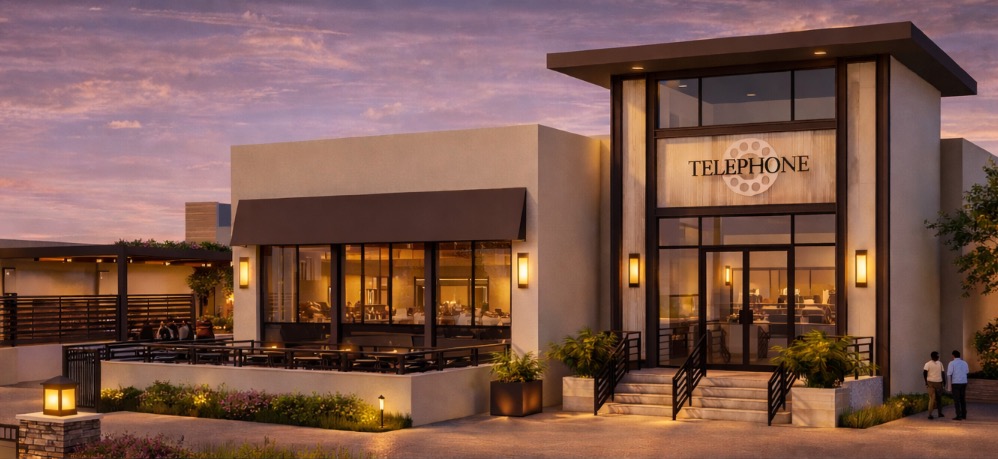
Kyle: Telepjone will be two large-format, full-service restaurants right in the heart of Downtown. We’re moving quickly on it.
Bri: You definitely are. How do you define large-format?
Kyle: Great question. The goal is to create the very best spaces for outstanding local operators to run exceptional restaurants. We’ve worked hard to deliver a set of true must-haves: high-visibility frontage along Old 41; substantial access from quieter side streets for loading and service; proximity to abundant parking; large kitchens with generous back-of-house space; indoor dining for roughly one hundred guests; well-protected outdoor seating for even more; and expansive, dynamic indoor-outdoor bars that create an energetic, social atmosphere.
Bri: Sounds like you have checked all the boxes. Why the name?
Kyle: We bought the parcels from a big company called Lumen, which had acquired them from CenturyLink, who acquired them from Sprint.
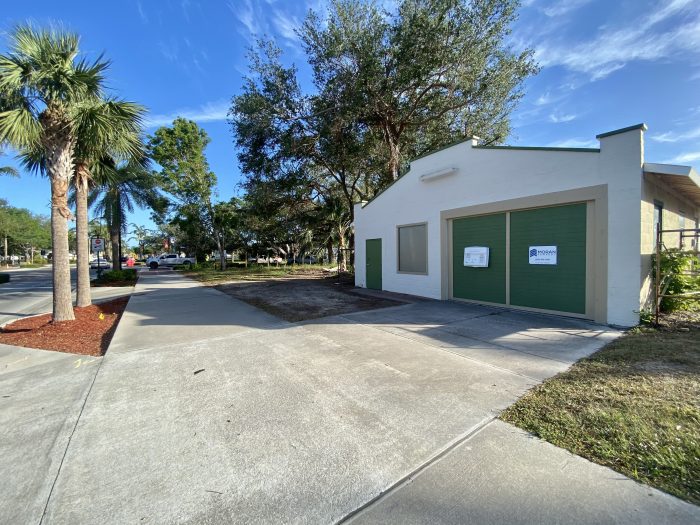
The site was originally developed and built by Intercounty Telephone and Telegraph. The main structure dates to 1957. It was a switching station for local phone lines. But it stopped housing telephone equipment decades ago. Until we got it, it was an empty building surrounded by ten-foot barbed wire fencing. We’re proud to be giving it a second life, just like we did with the old transmission shop for Sugarshack Downtown.
Bri: Another example of activation versus gentrification. It also feels a bit poetic – a building once used to connect people by phone line now doing so in person.
Kyle: (Laughs) I like that. I am going start using that line.
The fact is Downtown doesn’t have many older structures, but where we can reuse them, we try.
Simply put there wasn’t much here before the invention of air conditioning and the Second World War. Many spots in the world have buildings that are thousands of years old. Some places in the U.S. have buildings many hundreds of years old. The oldest building in Bonita is barely one hundred years old.
But we believe deeply in preserving history and repurposing buildings. Its good culture and good commerce.
We did it with the Sugarshack, but we also did it with a cottage on Felts Avenue built in 1943 that serves as the anchor office of our revitalization work in the Downtown. And now with this one.
Those buildings may no longer serve their original purpose – but they can still serve the community.
Looking Forward: The Future of Downtown Bonita
Bri: When you look ahead, what do you see for Downtown Bonita Springs?
Kyle: I see a community waking up – and then taking off.
Bonita is often underestimated. Behind the gates of its private neighborhoods sits one of the most economically powerful populations in the region – more people, more resources, and more momentum than many outsiders realize.
What makes Bonita different is that all that strength surrounds something rare: a true Downtown that belongs to everyone.
Even the most lavish private clubhouse eventually gets boring. A great Downtown never does. It pulses with energy – culture, chance encounters, and shared nights you talk about for years.
Great restaurants. Public festivals. Kayaks on the Imperial River. Music spilling into the street.
With projects underway, more on the drawing board, public-private partnerships with Barron Collier, new independent businesses opening, a City investing smartly in parks and programming, and catalytic connections like the BERT Rail Trail, Downtown Bonita is poised to rise to a new level – not just for itself, but for all of Southwest Florida.
Bri: I completely agree. We’ve believed in Bonita for a long time. My husband was born and raised here, and we’ve always known there was something special about this community, even when others underestimated it.
That belief is actually why we launched our blog and newsletter back in 2017. At the time, many of the proposed projects felt almost too ambitious for people to believe would really happen. We wanted to share what was coming and help people see the bigger vision for Downtown.
Seeing how far it’s come fills us with so much pride. The momentum is real – but what matters most is that as Bonita continues to grow, it doesn’t lose its charm. The community feel, the river, the events – that’s what makes it special.
We want to see it keep moving forward thoughtfully and intentionally, protecting the character that makes Downtown Bonita feel like home.

Kyle: We have got to keep going, and my focus is on delivering the best spaces as quickly as possible. But it’s really happening, and there are a lot of people to thank. City Council and an extraordinary city staff have done remarkable work Downtown. So many talented individuals and entrepreneurs have helped breathe life into the area. And I owe a tremendous amount to my partners at Moran Kennedy and Sugarshack Downtown. They are truly exceptional.
It shouldn’t surprise anyone that great people in a great place can produce great results – and that’s really the story of Downtown Bonita Springs.
Bri: Final question – when someone walks into HoneyHole Downtown for the first time, what do you hope they feel?
Kyle: Surprised – in the best way. Welcomed. Curious. Comfortable.
And I hope that years from now, when people think about their favorite memories, experiences at HoneyHole Downtown are part of that story. That’s what true landmarks do: they leave a lasting impression.,
We hope you’ve enjoyed following along with this three-part series and getting a deeper look at the vision, the momentum, and the people helping shape Downtown Bonita’s future. This is such an exciting season for our community, and we’re committed to continuing to keep you informed on what’s happening Downtown and across Southwest Florida – the projects, the progress, and the stories behind it all. If you’d like updates on HoneyHole, and other projects happening across SWFL delivered straight to your inbox, be sure to sign up for our newsletter below. And as always, if you ever have questions about the market, new developments, or finding your place here, we’re not just writing about this growth – we’re actively living it and helping clients navigate it every day.