A new project near Bonita Beach Road and Imperial River Road has sparked a lot of conversation in Bonita Springs, with many residents referring to it as the new “Bonita Springs data center.”
But according to city officials, the project is not a traditional large-scale data center like the massive AI and cloud-computing facilities making headlines across the country. Instead, it is expected to function more like a fiber optic communications hub tied to a new submarine cable system connecting Florida to Panama.
Here’s what residents should know about the Bonita Springs data center project, the vessel spotted offshore, and how this infrastructure fits into a much larger global internet network.
First, Is It Actually a Data Center?
The short answer is: not in the way most people think.
When people hear the term data center, they often picture enormous warehouse-sized buildings filled with thousands of servers that require massive amounts of electricity, cooling systems, backup generators, and water.
According to Bonita Springs Mayor Mike Gibson, that’s not what’s planned for this site.
Although zoning documents referred to the project the Bonita Springs “data center” because there wasn’t a better classification within the city’s land development code, the planned building will function primarily as an internet relay station—a relatively small facility that houses networking equipment used to transmit internet traffic between continents.
Mayor Gibson has described the project as being more comparable to a small office building with standard commercial utility connections rather than a high-demand AI computing facility.
Why Is It Being Built in Bonita Springs?
The answer lies offshore.
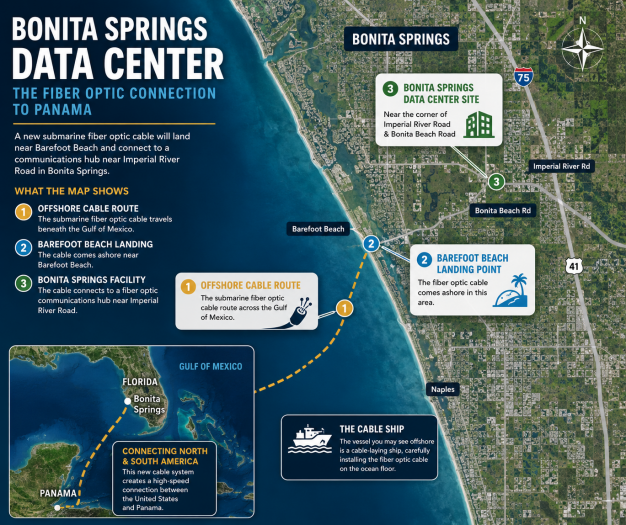
A new submarine fiber optic cable is being installed beneath the Gulf that will create a direct communications link between the United States and Panama, providing another high-capacity pathway for internet traffic moving between North and South America.
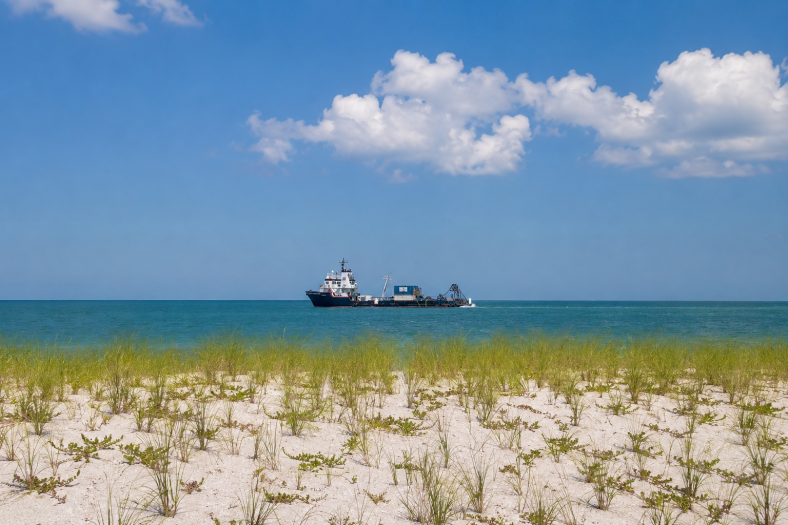
The offshore vessel many people have spotted in the Gulf isn’t conducting oil exploration or dredging.
Its job is to carefully install fiber optic cable along the seafloor.
Once the cable reaches the Florida coastline near Barefoot Beach, it will be brought ashore through underground infrastructure before connecting to the new communications hub on Imperial River Road.
From there, internet traffic can be routed into existing terrestrial fiber networks that serve the rest of the country.
How Does a Submarine Fiber Optic Cable Work?
Although the internet often feels wireless, nearly all international internet traffic actually travels through fiber optic cables.
These cables are about the size of a garden hose and contain strands of glass thinner than a human hair. Information travels through those glass fibers as pulses of light at incredible speeds.
Specialized cable-laying vessels slowly deploy the cable onto the ocean floor, carefully following engineered routes that avoid sensitive habitats and existing infrastructure. In shallow water, portions of the cable may even be buried beneath the seabed to provide additional protection from anchors and storms.
These submarine cable systems are the backbone of global communications, carrying everything from emails and video calls to financial transactions and cloud computing.
Who Is Building the Bonita Springs “Data Center”?
The Bonita Springs data center is being developed by Telcofacilities, a Miami-based digital infrastructure company that specializes in telecommunications facilities, submarine cable landings, and fiber optic networks.
According to industry reports, the Bonita Springs project is part of a much larger international initiative led by Telconet Latam, one of Latin America’s largest telecommunications infrastructure companies.
The new submarine cable—known as CSN-1 (Carnival Submarine Network-1)—will create a high-capacity fiber optic connection between Bonita Springs, Panama, Colombia, and Ecuador, improving internet connectivity between North and South America.
The approximately 2,800-mile (4,500-kilometer) cable is being manufactured and installed by Alcatel Submarine Networks, a global leader in submarine cable systems.
Industry publication BNamericas reports that the Bonita Springs facility will become the seventh edge data center in Telconet’s regional network. While local officials have emphasized that the building is not a traditional hyperscale data center, it will serve as a critical communications hub where the new international cable connects to existing U.S. fiber-optic infrastructure.
The project is part of Telconet’s broader $550 million investment in expanding digital infrastructure throughout the Americas.
What Will the Bonita Springs Facility Actually Do?
Rather than processing artificial intelligence workloads or storing enormous amounts of data, the facility’s primary role will be to monitor and manage the fiber optic connection.
Equipment inside the building will:
- Monitor the health of the submarine cable.
- Route internet traffic between international and domestic networks.
- House telecommunications equipment.
- Provide secure connectivity for the cable landing station.
According to city officials, only a handful of employees are expected to be on-site at any given time.
Why Are Some Residents Concerned?
Despite the city’s assurances, some nearby residents say they were unaware of the project until land clearing began.
Concerns have included:
- Property values
- Hurricane resilience
- Environmental impacts
- Generator noise
- Potential effects on nearby neighborhoods
- Protection of local wildlife, including gopher tortoises
The developer has applied to relocate gopher tortoises from the site in accordance with state permitting requirements.
Some residents have also questioned whether public notification regarding the project reached everyone who lives nearby.
Why the Confusion?
Much of the confusion stems from the language used during the zoning process.
Because Bonita Springs’ land development code doesn’t contain a specific category for an internet relay station or submarine cable landing facility, the project was processed using the closest available land-use designation.
That led to repeated references to a “data center” throughout public documents, even though city officials now emphasize that the building will operate very differently from the large-scale data centers making headlines across the country.
A Growing Piece of Global Infrastructure
While relatively modest in size, the project represents something much bigger than a single building.
As demand for faster and more reliable global internet connections continues to grow, new submarine fiber-optic systems are being built worldwide to improve capacity, redundancy, and reliability.
If completed as planned, Bonita Springs will become one of the landing points helping connect international communications between North and South America.
It’s not likely to become one of the giant AI data campuses seen elsewhere in Florida. Instead, it will quietly serve as an important link in the global internet network, moving information beneath the Gulf and across continents every second of the day.
To stay up to date on projects across SWFL, upcoming events, and more, join 8,500+ locals and subscribe to our newsletter!